Article
Why your month-end report disagrees with the floor
Four common places a manufacturing close drifts from what the shop actually produced, and how to tell which one you have.
 John Pereira · PresidentJune 2026

The controller says the month shipped at a 31 percent margin. The plant manager says the floor ran flat out and there is no way that number is right. They are both looking at the same ERP. In our experience the gap almost always comes from one of four places, and each one leaves a different fingerprint.
1. Labor posted late or not at all
Jobs close in the system on the day someone keys the last operation, not the day the part came off the machine. If labor from the last week of the month lands in the first week of the next one, this month looks cheap and next month looks expensive. The fingerprint: margins that swing in opposite directions from one month to the next, and a pile of open jobs with no activity in the final days of the period.
2. Material relieved at standard, bought at actual
Standard costs were set at the last update. Purchase prices moved since. The variance account is catching the difference, but it is posted in a bucket nobody looks at in the margin report. The fingerprint: product margins that look stable while the purchase price variance line quietly grows, and purchasing cannot explain why finance is surprised.
3. Work in process that never closed
A job gets 95 percent done, the last operation is skipped or the part ships from a different job, and the original job sits open with cost on it forever. Those dollars never hit cost of goods sold. The fingerprint: a WIP balance that only ever goes up, and a list of open jobs older than any lead time you quote.
4. Shipments and invoices in different months
The truck left on the 31st, the invoice was cut on the 2nd. Or the reverse. Revenue and cost land in different periods, and the margin for both months is wrong in opposite directions. The fingerprint: a shipment log and a sales journal that do not reconcile for the last and first few days of every month.
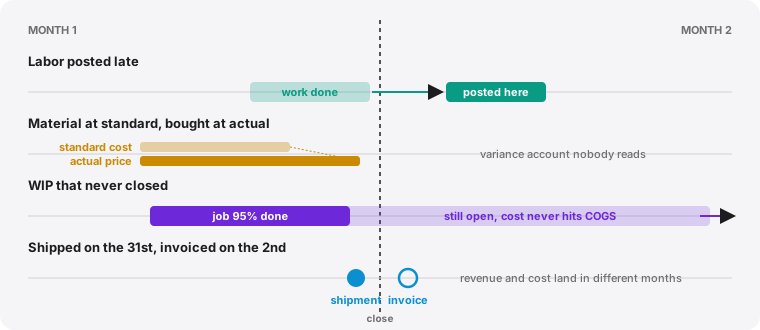 The four drift points, laid across the month boundary. Each leaves a different fingerprint in the data.
How to tell which one you have
Pull three lists before you argue about the number: open jobs with their last activity date, the purchase price variance trend by month, and shipments versus invoices for the last five days of the period. One of them will be obviously wrong. Fix that one first. In most shops two of the four are live at once, and the one that gets blamed is rarely the one that is largest.
A close everyone trusts is not a reporting project. It is the result of posting the work when it happens, closing jobs when they finish, and keeping standards near actual. The report is just where the discipline shows up.
More articles
Map the process before you automate it
Automating a workaround just makes it permanent. A short argument for documentation first.
Customizations that survive an upgrade
The difference between a change that costs you once and one that costs you every release.
Made2Manage BOM and costing reports
Costed and exploded BOMs, a cost estimating system we built for quoting, and part availability across on hand, committed and on order.
Made2Manage tools we built
Communication Center, Workflow Management and Sales Order Import: three products we built to fill gaps in Made2Manage.
Made2Manage production reports
Four reports we built to show what the floor is building, where it is scheduled, who worked on it, and how the plant is performing.
Made2Manage quality reports
Two reports we built: one finds everywhere else a defect could be, the other shows which vendors deliver when they promised.
Made2Manage sales reports
Backlog, net bookings, commission liability and gross margin by order, including a bookings system we built for ERPs that cannot track bookings on their own.
Skills, tools, and your ERP: where AI should actually touch the data
AI gets useful in a shop when it is given the right things in the right order: written know-how first, live data through controlled tools second, and the power to change anything last.