Article
Map the process before you automate it
Automating a workaround just makes it permanent. A short argument for documentation first.
 John Pereira · PresidentApril 2026

A customer asks us to automate order entry. We ask how an order gets entered today, and get three different answers from three people. One keys it from the email. One prints it, marks it up, and hands it to the first. One has a spreadsheet that nobody else knows about that fixes the part numbers first. All three are right. None of them is the process.
If we automate what the first person described, the spreadsheet step disappears and the part numbers start arriving wrong. We would have built a faster way to make the mistake.
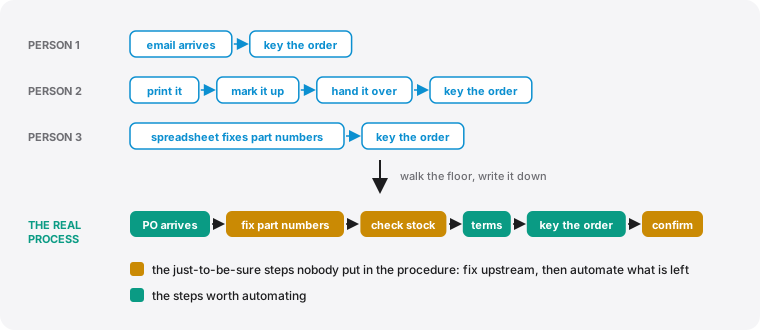 Three honest descriptions of the same job, and the process that actually runs. The highlighted steps are the ones automation would have locked in.
Workarounds look like process
Every workaround started as a fix for something the system or the process did not handle. Over time the fix becomes the way it is done, and the original reason is forgotten. Automation is very good at locking that in. Once the workaround is in code, it has a cost to change and an owner who will defend it.
Mapping first is how you find them. Not a flowchart from the manager's memory, but a walk through the actual work with the people who do it, writing down every handoff, every lookup, every place someone checks something "just to be sure." The just-to-be-sure steps are the interesting ones. Each is a signal that something upstream is not trusted.
What a map gives you
- The real sequence, including the parts nobody put in the procedure.
- The decision points, where a human applies judgment the system could not. Some of those should stay human. Some are rules nobody wrote down.
- The data that actually drives the step, which is often not the field the ERP thinks it is.
- The owner of each step, which is how you find out that a process has three.
With that in hand, automation gets smaller and better. Half the steps turn out to be compensating for a bad default, a missing field, or a report that lies. Fix those and the remaining work is simple enough to automate well.
It is faster, not slower
The objection is always time. Mapping feels like delay. In practice a few days of walking the floor saves weeks of building the wrong thing, and the map becomes the documentation and training material you were going to need anyway. We do not start an automation project without one, and we hand the map over whether or not the automation happens.
More articles
Why your month-end report disagrees with the floor
Four common places a manufacturing close drifts from what the shop actually produced, and how to tell which one you have.
Customizations that survive an upgrade
The difference between a change that costs you once and one that costs you every release.
Made2Manage BOM and costing reports
Costed and exploded BOMs, a cost estimating system we built for quoting, and part availability across on hand, committed and on order.
Made2Manage tools we built
Communication Center, Workflow Management and Sales Order Import: three products we built to fill gaps in Made2Manage.
Made2Manage production reports
Four reports we built to show what the floor is building, where it is scheduled, who worked on it, and how the plant is performing.
Made2Manage quality reports
Two reports we built: one finds everywhere else a defect could be, the other shows which vendors deliver when they promised.
Made2Manage sales reports
Backlog, net bookings, commission liability and gross margin by order, including a bookings system we built for ERPs that cannot track bookings on their own.
Skills, tools, and your ERP: where AI should actually touch the data
AI gets useful in a shop when it is given the right things in the right order: written know-how first, live data through controlled tools second, and the power to change anything last.